

This subject arrives late in a first call, usually after we have covered the schedule, the in laws and the money. Then there is a pause and somebody says, and also, we have not really been together in a while. The relief in the room when it gets said out loud is genuinely one of the more striking things in my work, because both people have been carrying it privately and each of them assumed they were the only one who minded.
I am going to keep this at the level I work at, which is the two of you as a couple. I am not a doctor and I am not a licensed professional, I do not diagnose, and I am not going to hand out techniques from a webpage. What I can do is describe the loop these couples get stuck in with some precision, because in my experience it is not mainly about sex at all. It is about what each of you concluded when it stopped, and neither of you has checked whether the conclusion was right.

The loop, from the inside
It usually starts with one ordinary bad night. Nothing dramatic. Somebody was exhausted, or distracted, or it just did not go the way it usually does. In a marriage with plenty of slack in it, that night gets absorbed and forgotten by Thursday.
But if the two of you are 7 years in with small children and running on fumes, it does not get absorbed. It gets thought about. The next opportunity arrives carrying the last one, and now there is an audience in the room, and the audience is you. That is the switch that flips: the thing that used to be a shared experience becomes a performance with a result, and the result is being watched.
Once that flips, anticipation does the rest. The evening starts being anticipated hours ahead. Then avoided, subtly. An early night alone, a series of very convenient late work emails, going to bed at different times for reasons that are always plausible. Nobody has decided anything. The calendar just starts arranging itself so that the test never gets taken.
How it moves
-
One ordinary night
Something did not go as usual. In a rested marriage this evaporates. In a depleted one it gets stored and reviewed.
-
The audience arrives
The next time carries the last time with it. Now there is a result to be got, and both people are watching for it.
-
The schedule reorganizes
Different bedtimes, a late email, an early night. No decision was ever made. The opportunity simply stops occurring.

What each of you concluded, and why it is wrong
Here is where the real damage happens, and it is not in the bedroom. It is in the two stories being told silently in the same house.
The partner who is anxious usually concludes that they are failing, that this is a fact about their body or their age or their worth, and that raising it would make it real. So they go quiet and they get busy. The withdrawal is not a message. It is management.
The other partner reads that withdrawal as the only thing it can plausibly mean from the outside: they do not want me anymore. Maybe they want someone else. Maybe they never really wanted me. That story then gets acted on, sometimes by pursuing harder, which raises the stakes and makes the next evening even more of an examination, and sometimes by pulling back and getting cold, which the anxious partner reads as confirmation that they have been found out.
Two people, both hurt, both protecting the other one, both entirely wrong about what is happening 6 feet away. That is the loop. It runs for years in perfectly good marriages and it is the single most fixable thing on this list, for the plain reason that it survives on silence and dies quickly when anybody says a true sentence out loud.
Inside one head
From the other side of the bed
I am frightened this will go badly again, so I am avoiding the moment.
He is not interested in me. Something has changed and nobody will say it.
I do not recognize my body since the baby and I do not want it looked at.
She flinches when I touch her. I have clearly done something wrong.
If I bring this up I have to admit out loud that there is a problem.
He would rather talk about anything on earth than this, so it must be worse than I thought.
I am exhausted in a way I cannot explain and desire has not been in the building for a year.
I am being rejected nightly by someone who used to want me.

Why the silence is the hard part
Couples will discuss money, in laws, a betrayal, a diagnosis in the family. They will not discuss this. Even in my office, where they are paying me by the hour precisely to say difficult things, this one comes last.
Part of it is that the vocabulary is terrible. Every available way to open the subject sounds like either an accusation or a request, and neither is what anybody wants to make. Part of it is that people are frightened of the answer. As long as nothing is said, the door is still theoretically open, and a specific conversation risks producing a specific verdict.
So it stays unsaid, which is the one condition under which it reliably gets worse. Nothing else in a marriage compounds this quietly. A money problem announces itself. This just recedes, month by month, until you look up and it has been 2 years and neither of you can remember how the conversation would even begin.
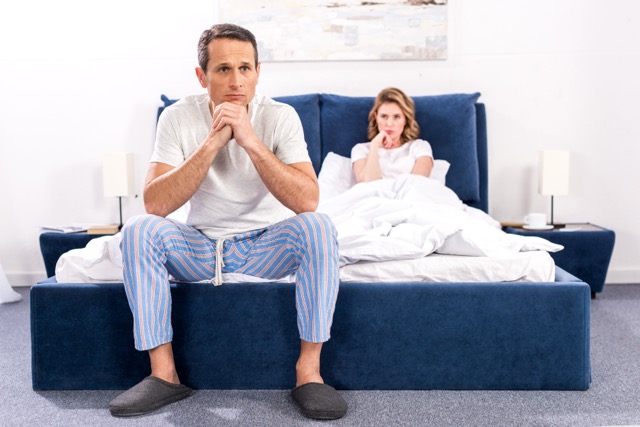
Two people in the same bed, both hurt, both protecting the other one, both completely wrong about what is happening 6 feet away.
Matthew W. Hoelscher, PCC

What the work looks like
I want to set expectations honestly. I am a couples coach. I do not give technique instruction, I do not prescribe exercises for your bedroom, and I would be skeptical of anyone offering that in an article. What I work on is the conditions, and in my experience the conditions are almost the whole of it.
The first move is making the subject sayable. That usually means one structured conversation, held deliberately, at a time of day when nobody is undressed and nobody is being asked for anything. The single most useful thing that happens in that conversation is each person discovering that the other one's silence meant something completely different from what they assumed.
The second is taking the scoreboard out of the room. As long as an evening has a pass and a fail, anxiety has something to grip. A great deal of this work is just lowering what any individual occasion is asked to prove, which sounds small and is not.
The third is separating this from the ordinary cooling that happens to everybody. The early chemistry of a relationship was always going to fade, and reading that fade as evidence of failure is what turns a normal change into a crisis. I go into that properly in how desire fades naturally. And if the two of you cannot get any hard sentence across the room without it becoming a fight, this is not the place to start. Start with how to improve communication in marriage.
Getting the subject out of the dark
-
Pick a time that is nowhere near bedtime and has no possibility of a request attached to it.
-
Each of you says what your own silence has meant. Not what you think theirs meant.
-
Agree out loud that no single evening is being asked to prove anything about the marriage.
-
Deal with the exhaustion problem as a real problem, because desire does not run on an empty account.
-
Check whether anything here belongs with a doctor or a licensed professional, and act on that first.

What is usually underneath it
Nine times out of ten, when a couple finally opens this up, the thing sitting underneath is not sexual at all.
It is that one of them has not felt like a person in 4 years. It is a body that changed after a pregnancy and never got acknowledged out loud by either of them. It is a resentment nobody named, running quietly since 2021, that makes closeness feel like a concession. It is two people who are excellent teammates and have not been anything else since the second child arrived. That is what I call the parent marriage, and the bedroom is usually where it shows up first, because it is the only part of a household that cannot be run on competence.
The work that actually changes this is rarely about the bedroom. It is about whether these two people are still reachable to each other anywhere. Get that back and this tends to follow, sometimes faster than anybody expected.
Where this stops being coaching work
I need to be plain about the boundary, because this is a subject where staying too long in the wrong hands costs people years.
If anxiety around sex is persistent, distressing, or has been going on long enough that it is affecting your daily life rather than one part of it, that belongs with a licensed professional. Same if there is pain, a physical symptom, or any question about what is happening in your body, which is a conversation with your doctor and not with me. Same if there is a history of sexual trauma in the picture, which is specialized work and not something a marriage coach should be improvising on. Same for abuse of any kind, an active addiction, or an untreated mental health condition. I do not diagnose and I do not treat, and I will tell you that on the first call rather than take your money and find out in month 3. Who I am the right person for, and who I am not, is set out plainly in who I actually work with.
Take this to a licensed professional
-
Persistent or distressing anxiety
If it is not confined to one part of your life, or it has become something you carry all day, that needs someone qualified to treat it.
-
Pain or a physical symptom
Start with your doctor. Nothing on a marriage page is medical advice and none of this should be guessed at.
-
A history of trauma
Specialized clinical work, led by a licensed professional. I will happily work alongside that on the marriage, but I will not lead it.

Talk it through
If the two of you are good at everything except this, and neither of you can find the first sentence, that is exactly the call to make. Book a free 25 minute call. It is for first timers, it costs nothing, and if what you describe belongs with a doctor or a licensed professional, I will say so and point you there.
Questions couples ask
Is it normal to feel anxious about sex with my own spouse?
It is extremely common and it is one of the least discussed things in marriage. It usually starts with a single ordinary night that got thought about too much, and then anticipation does the rest. What makes it worse is not the anxiety itself, it is the silence around it, because your partner is filling that silence with a story about rejection that is almost never what is actually going on.
My partner keeps avoiding intimacy. Does that mean they do not want me?
In my experience that is the most common wrong conclusion in this whole subject. Avoidance is usually management, not a message. The person avoiding is often protecting themselves from an outcome they are frightened of, or protecting you from what they assume you would think. You will not resolve this by watching for more evidence. You resolve it by asking, once, at a time of day when nothing is being requested.
Will you give us exercises or techniques?
No. I am a couples coach, not a clinician, and I do not give technique instruction. What I work on is the conditions around it: whether the subject can be said out loud, whether either of you is running on empty, whether a scoreboard has appeared, and what each of you has silently concluded. In most of the couples I see, that is where the actual problem lives.
When should we see a licensed professional instead?
If the anxiety is persistent or distressing, if it has spread beyond this part of your life, if there is pain or any physical symptom, or if there is a history of sexual trauma. Also if abuse of any kind, an active addiction, or an untreated mental health condition is in the picture. Those go to a licensed professional or to your doctor, and I will say so on the first call.