

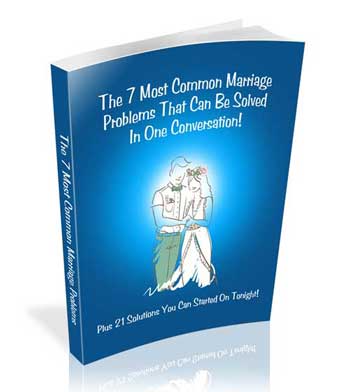
Years ago I wrote something for couples who were stuck and could not get started. Not a book you read cover to cover. Seven conversations, one per problem, so that a person could find the thing actually happening in their house, skip to it, and have a real conversation with their spouse that night.
It is still the most useful thing I have written, and the reason is not the content. It is that it removes the hardest part, which is the opening sentence. Almost every couple I meet knows roughly what is wrong. What they do not have is a way to bring it up that does not turn into the fight they have already had 40 times.
About the one conversation promise
The original title said these problems could be solved in one conversation, and I want to be straight with you about that, because I would say it differently now.
One conversation does not solve a marriage. What one conversation does is unstick it. Most of these problems have been sitting untouched for years, not because they are unsolvable, but because nobody has said the actual sentence out loud. The first real conversation is what moves a thing from unspeakable to workable, and that is genuinely most of the distance. But it is a start, not a cure, and anyone who tells you otherwise is selling something.
So read it that way. Seven doors. Each one opens something that has been closed. What happens after you walk through is the work.
What actually gets solved in one sitting
Not the problem. The silence around the problem. Couples routinely tell me the first honest hour changed more than the previous two years did, and then they still had two years of work ahead of them. Both of those things are true.
The seven conversations
Here they are, in the order I originally put them. The order is not accidental, but you do not have to take them in sequence. Find yours.
The seven
-
What is the purpose of our marriage?
-
Where is our desire and love?
-
How do we heal sexual shame?
-
How do we block out outside influences?
-
How do we reignite desire?
-
How do we get more honest with each other?
-
How do we let go of anger and resentment?
1. What is the purpose of our marriage
This is first because everything downstream depends on it and almost nobody has an answer. Ask two people separately what the marriage is actually for and you will usually get two different answers, both of them improvised on the spot, and that gap is upstream of most of what they came in fighting about. You cannot negotiate the terms of a thing when neither of you has ever said what the thing is for. The longer version of this one is what is our marriage.
2. Where is our desire and love
Not sex yet. This one is about where the wanting went, which is a different question, and it usually turns out that neither person knows the answer and both of them have a theory about the other. A lot of the pain here comes from reading a normal cooling as evidence of failure. It fades. That is not the problem. What you concluded about it is the problem. There is a fuller treatment on where our love and desire went.
3. How do we heal sexual shame
The one people skip and the one that is holding the most weight. Almost everybody arrives in a marriage carrying something about sex that they learned before they met each other, from a family, a faith, a bad early experience, or a decade of messages about what a body should be. It does not get discussed, so it gets acted out instead, and the spouse concludes it is about them. It is nearly never about them. I wrote this one up separately in overcoming sexual shame.
4. How do we block out outside influences
Your mother has views. His family has views. There is a friend who has been giving one of you advice for four years. In this city especially, the extended family is often a live participant rather than a distant relative. This conversation is not about cutting anybody off. It is about the two of you deciding, out loud and together, which opinions you are actually going to live by, because an opinion becomes a rule the moment it goes unexamined.
5. How do we reignite desire
This is the practical one and it comes after the first four for a reason. Two people who have not agreed on what the marriage is for, who have not talked about shame, and who are still running on other people's rules, are not in a position to rebuild a physical relationship. Every attempt turns into a negotiation about frequency. Do the first four and this one gets much shorter than you expect.
6. How do we get more honest with each other
Not honesty as in confession. Honesty as in ending the daily editing. Most couples are filtering constantly by year six, leaving out the difficult 20 percent to keep the peace, and after enough of that you are sharing logistics with somebody you used to tell everything.
7. How do we let go of anger and resentment
Last, and the one that makes the other six stick. Resentment is what unspoken things turn into after they sit. You can have all six conversations perfectly and still find yourselves back where you started, because there is a ledger nobody has closed. Putting it down is its own piece of work and I gave it a whole page in letting go of what no longer serves you.
Almost every couple knows what is wrong. What they do not have is a first sentence that does not start the same fight.
Matthew W. Hoelscher, PCC
The problem is not communication
The number one reason couples call me is that they say they have a communication problem. They are almost always describing something else.
Watch what actually happens. Two people get defensive and reactive fast enough that no listening occurs at any point. Both of them are talking, or one is sitting with visible patience composing a rebuttal, and neither is taking in a single thing. That is not a communication deficit. It is a listening deficit, and it is usually a weakness in both people rather than in one.
That is why these seven are written as conversations rather than as tips. A tip is something you do at your spouse. A conversation requires that somebody in the room receives something. Working through them is, more than anything else, practice at hearing each other again.
How to actually run one of these
-
Pick one. Not three. The one you both already know is the live one.
-
Pick a time that is not the moment. Not during, not after a fight, not at 11pm. A Sunday afternoon beats every evening of the week.
-
Agree on the length before you start. Forty minutes. Ending on time is what makes the next one possible.
-
One person talks all the way through. The other does not respond until they are finished. Then swap. No cross examination.
-
End with one thing each of you will actually do. Not a resolution to feel differently. Something a stranger could observe.
If infidelity is in the picture
The second most common reason people call me is betrayal, and I will be direct: that topic is bigger than one conversation and I am not going to pretend a page fixes it.
If you suspect or have confirmed any behavior you consider cheating, the order matters. Start with conversation 1, because you need to know what the two of you thought you were in before you can work out what was broken. Then conversation 7, because the resentment will otherwise sit under everything you say. Then conversation 6. Then get a third person in the room, quickly, because the early conversations after a betrayal are the ones most likely to turn into the fight that ends things, and they do not need to.
Betrayal is coaching work in my practice, not a wound I hand off. I sit in it constantly. What it needs is speed, structure, and someone whose job is to keep the first conversations from going somewhere they cannot come back from.
Where these conversations are the wrong tool
-
Abuse of any kind
Physical, sexual, or a pattern of intimidation and control. Do not sit down for an honest conversation with someone who is not safe. That belongs with a licensed professional or a domestic violence resource, today.
-
An active addiction
Until that is being treated, every agreement made in these conversations gets broken by something neither of you is actually addressing.
-
An untreated condition
If depression or an anxiety disorder is driving what is happening, a licensed professional leads. I am a coach. I do not diagnose and I do not treat, and I will tell you that on the first call.
Why couples never start
Here is the honest reason these do not get used, and it is not time.
Starting one of these conversations means admitting out loud that something is wrong, and for a lot of couples that admission feels more dangerous than the problem. As long as nobody says it, the marriage is officially fine. The day somebody says it, it is officially not, and neither of you knows what happens next.
That fear is understandable and it is backwards. The problem is already in the room. It has been in the room for years, doing damage on a schedule. Saying it out loud does not create it. It just gives the two of you something to do about it, and in my experience the relief in the room when somebody finally says the true sentence is enormous, even when the sentence is hard.
Talk it through
Some couples run these on their own and it goes well. Others get 10 minutes in and hit the wall they always hit, which is exactly what the room is for. Book a free 25 minute call. It is for first timers, it costs nothing, and I will tell you which of the seven I would start with in your situation, and whether this is coaching work at all.
Questions couples ask
Can these problems really be solved in one conversation?
One conversation does not solve a marriage and I would not claim it does. What it does is end the silence around a problem that has been sitting untouched for years, and that is most of the distance. Couples routinely tell me the first honest hour changed more than the previous two years, and they still had real work ahead of them.
Which conversation should we start with?
The one you flinched at when you read the list. If nothing stood out, start with number one, what the marriage is actually for, because every other conversation depends on the two of you having an answer to it. If betrayal is in the picture, take 1, then 7, then 6, and get help early.
What if my spouse will not sit down for this?
Tell them the topic in advance and give them a length. A lot of refusals are not refusals of the conversation, they are refusals of an ambush with no end time. If it is still a no, start alone and work on your half of the pattern, which is the only half you control anyway.
Is this enough on its own, or do we need someone in the room?
Depends on where you are stuck. Couples with goodwill still in the bank often run these fine at home. Couples who are defensive within 90 seconds will not get through one unaided, and that is not a character failure, it is what a well practiced pattern does. That is precisely what a session is for.